How to win the CFP: 3 key battles to decide the national title
The college football world descends on Miami to decide the national champion after five months of incredible action.
Few people likely picked an Indiana-Miami title matchup at the beginning of the season, but those are the two left standing in the College Football Playoff.
Although the Hoosiers enter as significant favorites, the Hurricanes could celebrate a memorable home win if they can shift the outcome of several key battles.
Here are three matchups to watch that'll shape the game's results.
Indiana D-line vs. Miami O-line
Mario Cristobal's roster-building philosophy is essentially based around procuring massive humans to move people out of the way on a play-by-play basis. From that perspective, the matchup against Indiana should be ideal for Miami. The Hurricanes' starting offensive line dwarfs the Hoosiers' defensive front.
Looking ahead to Indiana-Miami, one thing that stands out is the size disparity in the trenches.
— Nick Rodecap (@NickRodecap) January 11, 2026
Indiana D-line avg: 278 lbs
Max weight: Tucker (302)
Miami O-line avg: 331 lbs
Max weight: Bell, Cooper (345)
On average, that's a 53 lb difference -- significant. #iufb https://t.co/TEbdmXcr2O
However, this ain't a UFC weigh-in, and games aren't played on a scale. Despite running out that undersized line, Indiana leads the country in tackles for loss and ranks third in sacks. Insert the cliche: 'It's not the size of the dog in the fight, but the size of the fight in the dog.' An elite scheme that thrives on confusion and utilizing speed off the edge can easily overcome a lack of size. Just ask Oregon's Isaiah World, who ESPN's Mel Kiper ranks No. 8 among tackles in the 2026 NFL Draft.
.@IUHoosiers EDGE Mikail Kamara spin cycle…🌪️ pic.twitter.com/liL9lUoiFz
— Cole Cubelic (@colecubelic) January 12, 2026
Indiana has posted six sacks and 16 tackles for loss through two playoff games, as neither Alabama nor Oregon figured out how to stop the Hoosiers' front.
Miami's offensive success has always hinged on running the ball, and Mark Fletcher Jr.'s playoff breakout is one of the main reasons the team's still here. Fletcher has been a menace in three postseason contests, averaging 131 rushing yards per game. However, a deeper look shows that he and the rushing attack have greatly benefited from favorable matchups, with Texas A&M and Ole Miss boasting defensive units ranked in the 60s nationally against the run. Fletcher still put up 90 yards on Ohio State's seventh-ranked line, but he needed 19 carries to get there, well below the yard-per-carry average he showed versus the Aggies and Rebels.
For the Hurricanes to have a shot Monday, Fletcher and the running attack need to succeed and not put added pressure on Carson Beck's shoulders.
Bain and Co. vs. Mendoza
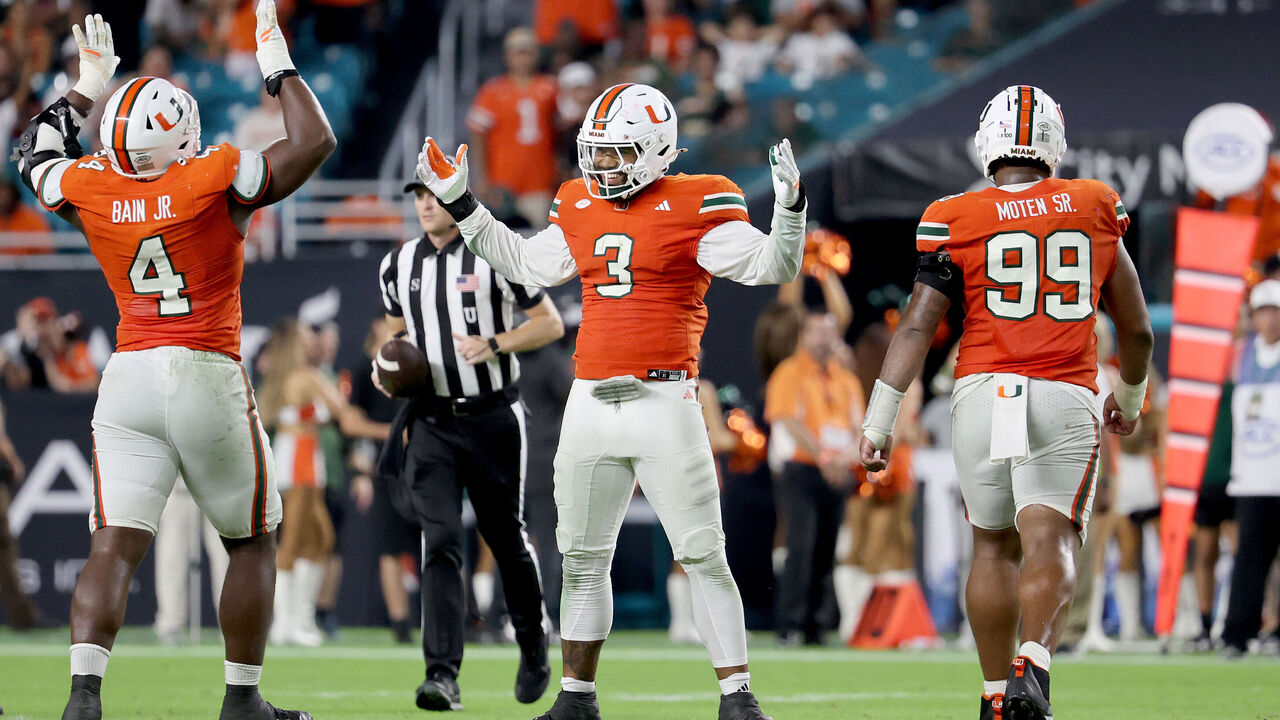
When Indiana has the football on Monday, we'll be treated to a true strength-versus-strength matchup. On one side is a man playing out of his mind in the playoffs, Heisman winner Fernando Mendoza. The Miami native has thrown eight touchdowns through two postseason games while missing just five total passes. More touchdown throws than incompletions seems incomprehensible in the playoffs, yet that's what Mendoza has done.
The other side will see the nation's top pass-rushing unit try to get to Mendoza and alter those numbers significantly. Rueben Bain and Akheem Mesidore represent arguably the best pass-rush duo in the country, both ranked in the top 10 by Pro Football Focus. The two move all over the defensive line, but you can expect them to target Indiana right tackle Khalil Benson frequently. If there's a weak link on the Hoosiers' line - a big 'if' given their production - it's Benson, who Oregon burned for multiple sacks last time out.
One way to slow down Bain and Co. is to get the ball out quickly, something Ole Miss did with some success last week. Trinidad Chambliss places among the top quarterbacks with an average time to pass of 2.58 seconds per dropback. That's much quicker than Ohio State's Julian Sayin and Texas A&M's Marcel Reed - both are close to three seconds. Mendoza falls in between Chambliss and the rest at 2.72 seconds on the season. Don't be shocked if Indiana's early passing attack calls for a number of quick throws to get Mendoza comfortable and keep the pass rush at bay.
The Hoosiers could also employ a quick tempo to slow down Miami's front after watching Ole Miss successfully execute the strategy. The Rebels' offense ranks 14th nationally in time between plays, while previous Miami opponents, Ohio State and Texas A&M, both fall outside the top 100. Indiana is 127th in that category, so speeding up would represent a stark departure from how the Hoosiers got to the title game.
3rd-down defense vs. 3rd-down offense
Indiana has built the largest point differential in CFP history by breaking its opponents' will every week. The Hoosiers love nothing more than to take an early lead and run away from the competition like peak-Usain Bolt at the Olympics. The best way to accomplish that is to excel in third-down situations, relentlessly denying the opposition a break.
The Hoosiers' offense is an outrageous 20-for-28 on third downs in these playoffs - an astonishing achievement considering Alabama and Oregon entered their matchups limiting opponents below a 40% conversation rate. That type of efficiency usually reflects the presence of an elite quarterback who makes excellent decisions, and Mendoza has shown that all season. He'll face his toughest test Monday, as Miami's third-down defense has feasted over the past two outings. Ohio State and Ole Miss combined to go just 5-for-20 on third downs, with the Hurricanes' pass rush forcing poor choices by Sayin and Chambliss.
Third-down conversions for Miami's offense might just be the most important statistic on its path to victory. The Hurricanes aren't likely to keep up with the Hoosiers in a shootout, so long sustained drives will be vital for the underdog. Beck and the offense did that at an exceptional level in the semifinal, going 13-for-22 on third and fourth downs and piling up an absurd 23-minute time of possession advantage.
HEADLINES
- Kentucky AD Barnhart retiring in June
- Judge declares mistrial in Rashaun Jones trial over Bryan Pata's 2006 killing
- 7-foot alligator hisses, snaps at Florida's Sumrall during photoshoot
- Indiana's Cignetti cashes in with 8-year extension worth $13.2M annually
- Colorado quarterback Dominiq Ponder dies at age 23