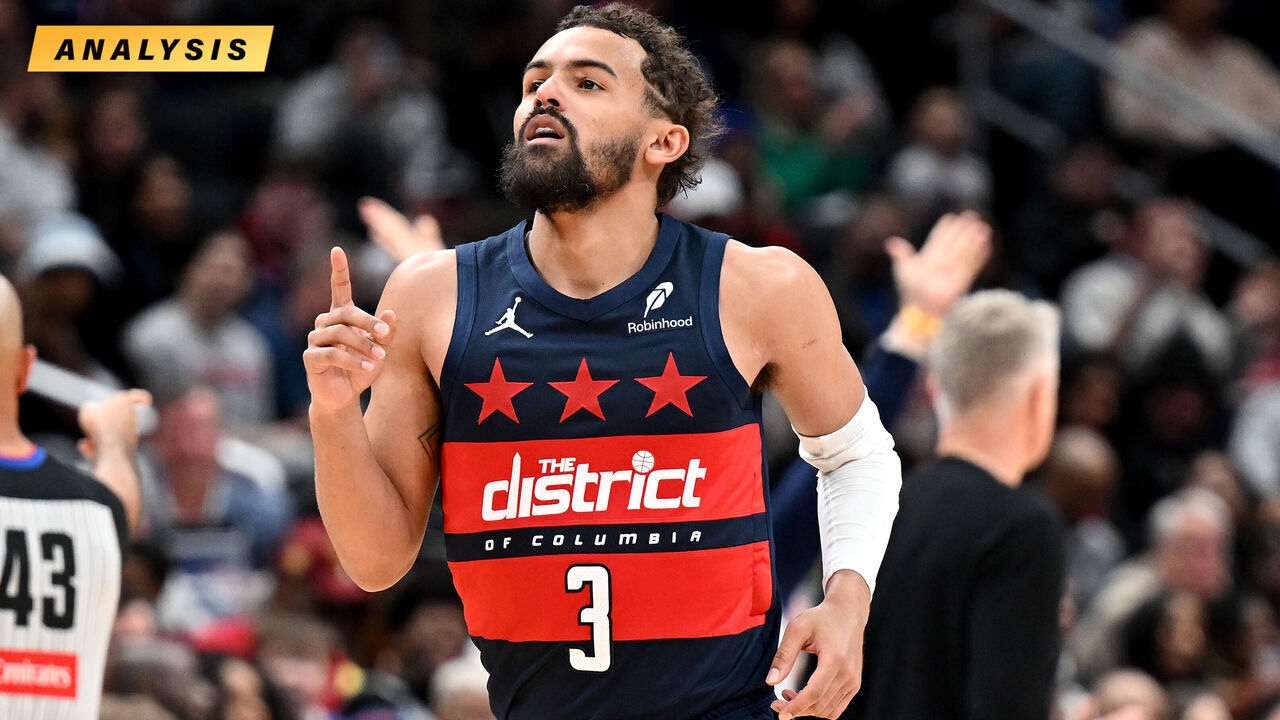
Armed with the No. 1 overall pick in a loaded draft class and a stable of intriguing young talent, the Washington Wizards were finally on the verge of turning a new leaf. Then they reportedly handed Trae Young $212 million.
In what amounts to a gross miscalculation, the Wizards will be paying Young an average of $53 million per year over the next four seasons, with a starting salary worth about 30% of the cap. Washington ended up giving Young the maximum amount a rival team could've offered over four years, and he reportedly received a player option in the final year of the pact.
The contract is a massive victory for the four-time All-Star, who declined a roughly $49-million player option for next season. The logical assumption among NBA observers was that the Wizards would retain Young on a medium-length (two- or three-year) deal that would still provide him with some semblance of security while decreasing his annual cap hit. Instead, he secured a larger average salary despite coming off an injury-riddled season (just 15 contests played) and facing serious questions about the feasibility of his game.
With so few teams boasting max cap space, who were the Wizards bidding against a week before free agency even tips off? And if Washington did catch wind that a rival suitor was willing to break the bank for Young, why didn't it just let that team be the one to overpay him? After all, one of the reasons the Wizards' buy-low acquisition of Young made sense at the trade deadline was that they didn't need to feel bad if they lost the potential free agent on the open market.
That's not to say Young won't help the Wizards on some level. The 27-year-old can still be a terrific offensive engine at his best and an elite playmaker at his worst. The 2024-25 assists champion averaged 26.5 points and 10.2 assists between 2019 and 2025, and he'll create the best looks young players like Alex Sarr, Tre Johnson, and Kyshawn George have ever had. However, Young is also a ball-dominant, one-way star who doesn't score efficiently enough to justify the debilitating defensive issues he brings to the table.
Can the defensive brilliance of Sarr, potential No. 1 overall pick AJ Dybantsa, youngster Bilal Coulibaly, and Anthony Davis - assuming the veteran big man sticks around - insulate Young enough to turn Washington into a winner? It's true that the Knicks just won a championship with the undersized Jalen Brunson playing a starring role, but Brunson is much stronger and tougher than Young.
Plus, Washington shouldn't even be thinking about rushing to construct a contender. The Wizards should focus on how best to develop Dybantsa (or whoever they take first overall in the draft) in addition to their other impressive prospects. Young's playmaking might help, but it's just as likely his empty-calorie, high-usage ways could stunt a top prospect's growth if he doesn't significantly shift his style of play.
When the Wizards bought low on Young and Davis at the deadline, many wondered whether Washington might be able to flip the veterans for surplus value to continue stockpiling future-minded assets. Perhaps that's still possible with Davis, who's owed up to $121.2 million over the next two years. But it's certainly not with Young, whose contract could quickly become an albatross in a post-aprons world, where teams have become wary of giving max money to stars who don't provide max impact.
Though the Wizards' bevy of rookie-scale contracts makes Young's new deal more palatable, it's still bad business in a league designed to punish poor asset management. Winning the draft lottery gave Washington every reason to continue its patient rebuild rather than prioritizing the windows of its recently acquired veterans. So much for that.
Maybe the Wizards felt this was exactly the type of swing they needed to take, more than 47 years removed from their last conference finals berth or 50-win season. In reality, it's the kind of decision that explains how such a drought is possible.
Joseph Casciaro is theScore's lead NBA reporter.