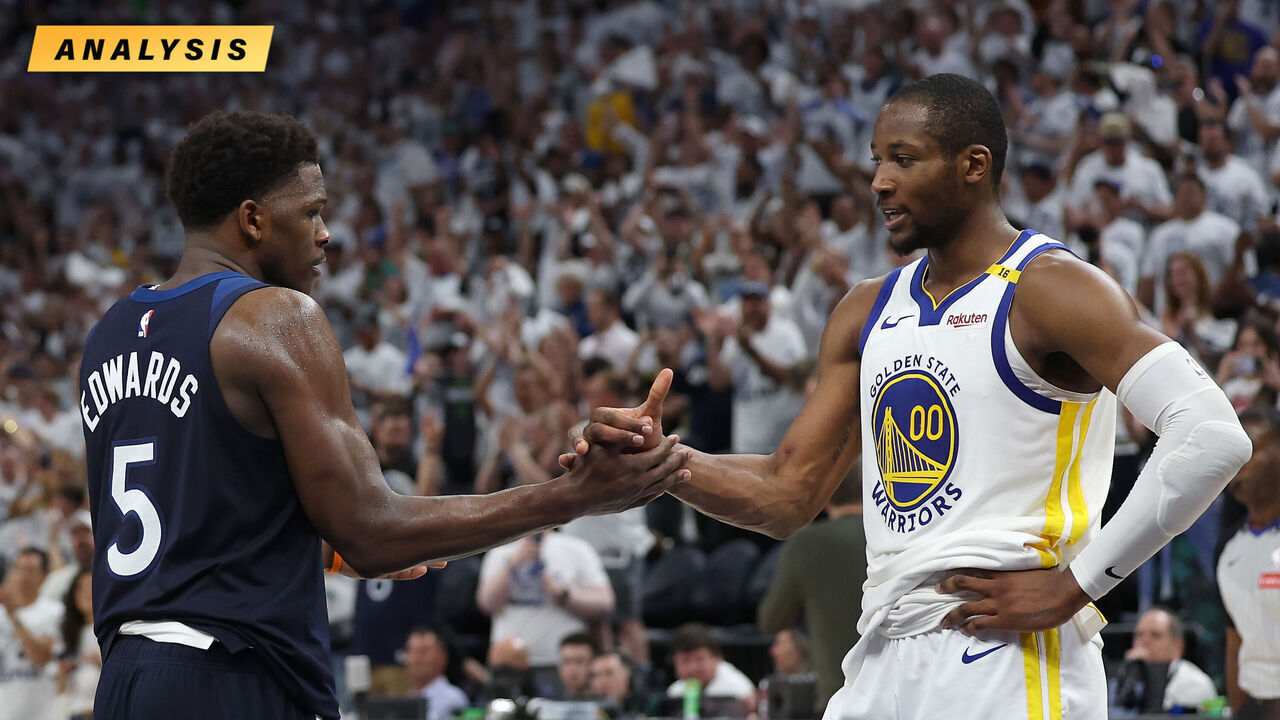
We're in the middle of a wild NBA offseason. Here, you'll find our analysis of every notable deal.
Aug. 26
Timberwolves sign Kuminga (2 yrs, $12.4M)
Amidst a turbulent start to his NBA journey, perhaps the most encouraging stretch of Jonathan Kuminga's career came during a 2025 playoff series against Minnesota. How fitting that it's the Timberwolves who've opted to take a flier on Kuminga about a year and a half later.
Even with a second-year player option, Kuminga's minuscule 3.7% cap hit makes him a low-risk, high-reward bet by a Wolves team suddenly looking for a solution at power forward. However, it's unlikely the wager will pay off. Kuminga's a poor shooter who's inefficient on the ball and doesn't do much off of it, which is where he figures to spend most of his time on a team boasting scorers like Anthony Edwards, LaMelo Ball, and Ayo Dosunmu. Defensively, Kuminga's never made the most of his athleticism.
There's no harm in trying if you're an all-in team with few avenues to improve, like the Timberwolves, but there's a reason Kuminga fell out of favor in Golden State despite being a former seventh overall pick. Just like there's a reason the Hawks declined his team option despite Kuminga's decent stretch of ball in his brief stint with Atlanta. Can he and the Wolves prove everyone wrong?
Pelicans sign Mathurin (2 yrs, $16M)
Bennedict Mathurin is finding out the hard way that it's never been less lucrative to be a one-dimensional scorer. Averaging 16.2 points per game in his four-year career, the 24-year-old is elite at drawing fouls and should only be approaching his prime. Mathurin projects as the type of player who could be in Sixth Man of the Year conversations for the foreseeable future, but his overall impact doesn't measure up. That's why his market was reportedly lukewarm, at best.
Among 160 players with at least 80 games played and a usage rate above 20% over the last four years, Mathurin's career free-throw-attempt rate (FTA per FGA) of .428 ranks 11th. However, his subpar shooting from the field (49.9% eFG) limits his overall efficiency. Among those same 160 players, Mathurin's true shooting percentage ranks 91st. He's also recorded more turnovers than assists, and his defensive work is inconsistent.
Mathurin now joins an ill-fitting Pelicans squad already bursting with one-way players. And with a second-year player option that could allow him to test unrestricted free agency next summer, the youngster has every incentive to fire away. This seems like a clunky fit on a bad team.
Aug. 21
Nuggets sign DeRozan (1 year, $3.9M)
If there's one thing DeMar DeRozan will continue to do, it's get buckets. The six-time All-Star has averaged at least 18 points per game in 14 consecutive seasons, and his career scoring total of 26,711 points ranks 16th all time. Even as a poor long-range shooter, DeRozan has managed to score on above-average efficiency in six of the last seven seasons. That's a testament to his mid-range prowess, brilliant footwork, and general craftiness. The 37-year-old is also an underrated playmaker who limits turnovers. In short, he still has plenty of offensive utility and could provide a nice boost off Denver's bench.
On a minimum contract and in a reserve role for the first time in his career - DeRozan has come off the bench only 12 times in 1,264 games - the 17-year veteran should prove more than worth it.
Having said that, DeRozan is a very poor defender who no longer puts pressure on the rim and can't shoot from deep, and he's joining a team that needs more shooters, defenders, and attackers. Even if there's no risk to signing him, it doesn't mean the future Hall of Famer will help Denver much in the grand scheme of things. Keep in mind that between Peyton Watson and Tim Hardaway Jr., the Nuggets lost a combined 305 made 3-pointers (on 41% shooting) from last year's team.
Heat sign Thompson (2 yrs, $13M)
Once Klay Thompson and the Mavericks reached a buyout agreement, Miami was top of mind for anyone paying attention. The Heat desperately need shooting around Giannis Antetokounmpo and Bam Adebayo, and while Thompson can't provide the off-the-dribble creation Miami lacks, he can certainly still stroke it. Even in two "down" years (by his legendary standards) as a Maverick, Thompson shot 38.7% from deep on nearly eight attempts per game.
Thompson, whose previous contract would've netted him $17.5 million this coming season, will reportedly now earn about $6.3 million instead, but he did secure a $6.7-million player option for 2027-28.
Aug. 20
Cavaliers re-sign Harden (3 yrs, $97M)
In what likely represents the last big contract of his legendary career, James Harden's latest agreement with the Cavs will push his career earnings over the half-billion-dollar mark. Though Harden's new pact is a year longer than we projected, an average annual salary of roughly $32.3 million aligns with expectations. As staggering as those figures sound, they're far from outrageous.
Harden's contentious exits from some of his former teams and his postseason failures are well documented, but the 36-year-old remains a durable, productive star. Cracking the 70-game mark last season for the third straight year, Harden averaged roughly 24 points, eight assists, and five rebounds per contest between Cleveland and Los Angeles. He also shot roughly 50% inside the arc, 38% from deep, and 88% from the free-throw line.
Harden, entering his 18th season, should remain a borderline All-Star or an above-average starter at worst, which makes his roughly 20% cap hit palatable.
As a team, the Cavs rebounded nicely after LeBron James spurned them (again). Cleveland retained Harden while adding Peyton Watson (see below), Mario Hezonja, and Cam Whitmore. The organization also extended Donovan Mitchell. That contract may very well prove too long and pricey, but the Cavaliers are all-in. Given the options in front of them, they couldn't have done much better this summer.
A starting lineup of Mitchell, Harden, Watson, Evan Mobley, and Jarrett Allen gives the club a balanced core - and a nice blend of youth and wisdom - all under contract for multiple years. It also gives the Cavs at least a puncher's chance in a suddenly stacked Eastern Conference.
Aug. 19
Nuggets sign-and-trade Watson to Cavs (4 yrs, $88M)
Cavaliers receive: Peyton Watson, Cam Whitmore
Nuggets receive: 2031 1st-rd pick (via CLE), 2032 2nd-rd pick (via SAC), Julian Reese (waived)
Clippers receive: Max Strus
Wizards receive: Tre Mann, 2027 2nd-rd pick (via PHI), cash
Hornets receive: Dennis Schroder, cash
The Cavaliers have long been searching for a starting-caliber small forward to plug between their dynamic backcourt and giant frontcourt. In 23-year-old Peyton Watson, Cleveland appears to have filled that void for the foreseeable future.
Watson may never be a star, and injuries have limited him to an average of 56 games per season over the first four years of his career, but he has the tools to be a two-way stud. Watson's a 6-foot-8 forward coming off a season in which he averaged nearly 15 points per game while shooting better than 41% from deep. He also thrived during his first real stretch of consistent star usage. During a 13-game span in January while Nikola Jokic was sidelined and both Jamal Murray and Aaron Gordon missed time, Watson averaged 23.1 points, 6.3 rebounds, and 2.7 stocks on an effective field-goal percentage of 58.2.
The Cavs don't need him to be that player, and an average cap hit in the 12%-13% range could prove to be a bargain after many projected Watson for a nine-figure contract. Watson merely playing up to his usual standard would give Cleveland the kind of youth, athleticism, and two-way upside the fringe contender needed but didn't look capable of acquiring until he landed in its lap.
The Cavs spending their last tradable first-rounder to get this deal done was well worth it for a team as all-in as they are (Cleveland can still offer first-round swap rights in 2030 and 2032). Taking the entire transaction into account, Cleveland turned Strus, Schroder, a first-round pick, and a second-rounder into a long-term starter. That's fine business.
For what it's worth, the Cavs also still have nearly $30 million under their first-apron hard cap to re-sign James Harden.
As for the Nuggets, that unprotected 2031 first-rounder could be valuable, but it's hard to see this transaction as anything but another cheap decision by team ownership. That's inexcusable for a club that should be committed to winning at all costs during Nikola Jokic's prime.
Watson, a restricted free agent, ended up signing a fairly team-friendly contract, but he won't be playing for the Nuggets. Was one distant first-round pick worth it? The only way Denver can make it so is if the team flips that pick for the type of player that can help Jokic sooner than later.
Finally, good on the Clippers for turning a second-round pick (originally from Philadelphia) into Strus. The 30-year-old is a tough player and good shooter who recovered from a Jones fracture to average 11.2 points on 61% true shooting in 12 games last season. Strus is set to earn $16.7 million in the final year of his contract, but he could prove to be a great pickup for the Clippers if he rebuilds his value in Los Angeles, even if it's ultimately as a trade chip who nets the Clips more than they paid to acquire him.
Aug. 13
Clippers re-sign Beal (2 yrs, $13.2M)
After reportedly exploring options outside Los Angeles, Bradley Beal will return to the Clippers on a non-Bird exception, which allows L.A. to give the three-time All-Star a starting salary worth 120% of his 2025-26 salary. Beal also has a player option for 2027-28, allowing him to test the market again a year from now if he can rebuild his value during the coming season.
He'll have to stay healthy to do it. Beal, 33, missed most of last season recovering from a serious hip injury (and hip surgery), and he's missed more than half of his teams' games over the last five years. When the new season tips off, Beal will also be six years removed from his last All-Star appearance and lone All-NBA selection. If he can stay on the court, expect Beal to score efficiently in whatever role he fills. But that's a big if.
Aug. 5
Suns extend Brooks (3 yrs, $73M)
The Suns continue to reward the scrappy role players who helped Phoenix overachieve in 2025-26.
Say what you will about Brooks' antics and his lack of self-awareness as a shooter, but there's a reason the veteran forward seems to win wherever he goes. He's an unflappable two-way player who takes pride in locking up the game's biggest stars - or at least trying his darnedest to. He's also coming off a shocking scoring season in which he averaged a career-high 20.2 points. An average annual salary of more than $24 million between his age-32 and age-34 seasons might sound steep, but Brooks isn't projected to earn even 14% of the cap in any of those years. This deal should remain fair to Phoenix while being moveable if the team eventually decides to pivot.
The Suns are now beyond pot-committed to a mediocre team for the foreseeable future, but as noted below, they don't have much of a choice. The franchise only controls one of its own first-round draft picks over the next seven years, leaving it no incentive to bottom out. All Phoenix can do for the remainder of Devin Booker's prime is continue trying to compete on some level. Whether the Suns are going about that the right way is debatable (see their June 28 deal for Miles Bridges below), but you can't say they're not trying.
Aug. 2
Mavericks extend Marshall (3 yrs, $52.2M)
Naji Marshall's career year last season said more about how depleted the Mavericks were than it did about any sizable leap in his game. He continued to struggle shooting from long range and his defensive consistency slipped, but that's what happens when a role player is forced to shoulder an outsized offensive load. Marshall remains a tough and physical forward who can get to the rim and guard opposing stars. The 28-year-old, who's averaged 14.3 points over the last two seasons while shooting roughly 60% inside the arc, should thrive in a reserve role on a healthier version of the Mavs.
Dallas now has Marshall under contract through 2030, with his cap hits ranging from roughly 6% to 11% over the next four years. That should net the team plenty of surplus value.
July 28
Warriors re-sign Green (1 year, $27.7M)
The Warriors pivoted from their failed attempt to land LeBron James by getting Draymond Green back on their books after he initially declined his 2026-27 player option - worth roughly the same amount as his new one-year contract - to help the Warriors create space for James.
At 36 years old, Green is far removed from his prime, and his offensive limitations have only become more magnified. However, he remains one of the league's most impactful defenders and sharpest basketball minds. Green will continue to help the Warriors next season, and on a one-year deal, there's no long-term risk associated with his age. It's also worth noting that Green's large salary can still be used for salary-matching purposes in a potential trade. Usually, a player with bird rights who signs a one-year contract effectively receives a no-trade clause, but Green has reportedly agreed to waive that implied no-trade clause.
Green's contract will expire at the same time as Steph Curry's and Jimmy Butler's. In addition, fellow Warriors veterans Kristaps Porzingis and Al Horford have player options for 2027-28, and youngster Brandin Podziemski could be a restricted free agent next summer, leaving Golden State with more projected 2027 cap space than any other team. After striking out on James and Giannis Antetokounmpo, will the Warriors turn their attention toward a potentially star-studded 2027 free-agent class to find Curry's next running mate? Nikola Jokic, Kevin Durant, Kawhi Leonard, Karl-Anthony Towns, and Anthony Davis are just some of the names who could hit the market.
July 24
76ers sign LeBron James (2 yrs, $8M)
LeBron James' "last decision" was to join the already loaded Philadelphia 76ers. For a deeper dive into how James fits the new-look Sixers, click here. You can also read about what comes next for the teams LeBron rejected here.
July 21
Lakers sign Thybulle (1 year, $3.3M)
The Lakers desperately needed to ensure that new starting center Walker Kessler wasn't left to clean up Los Angeles' defensive mess of a roster all by himself. In Matisse Thybulle and the recently acquired Ziaire Williams, the Lakers have begun to address those deficiencies (especially on the wing).
Thybulle's durability is a point of contention: After averaging 69.6 appearances per 82 games over the first five years of his career, the 29-year-old missed 119 games over the last two seasons due to thumb, ankle, and knee injuries. However, on a cheap one-year deal, this is a low-risk, high-reward addition for the Lakers.
Thybulle is an elite stopper and defensive playmaker who's offered glimpses of an improved 3-point stroke. The 6-foot-5 wing player converted 41.1% of his long-range attempts over those last two injury-derailed seasons, and he should get plenty of open looks playing with Luka Doncic and Austin Reaves. It wouldn't shock me if a healthier version of Thybulle nudges his way into the Lakers' starting lineup at some point.
July 19
Hawks land Dort in 3-team trade
Oklahoma City's summer of cost-cutting continues, as the Thunder reportedly traded Lu Dort to Atlanta for three second-round draft picks as part of a three-team transaction that includes the Mavericks. Within the deal, the Hawks sent former No. 1 overall pick Zaccharie Risacher to Dallas in exchange for Ryan Nembhard.
The Thunder have now moved below the second-apron threshold following a series of offseason departures, with Dort joining the likes of Isaiah Joe and Aaron Wiggins on the list of players Oklahoma City has dumped. The departures of those three players - plus new (and smaller) salaries for Isaiah Hartenstein and Kenrich Williams - trimmed the team's expenditures by a whopping $317 million, according to salary-cap expert Yossi Gozlan.
OKC will remain above the first apron, but the 2025 champions will avoid the harsher second-apron penalties while still boasting a stacked roster that includes Shai Gilgeous-Alexander, Chet Holmgren, Jalen Williams, Hartenstein, Alex Caruso, Cason Wallace, Jared McCain, Ajay Mitchell, Jaylin Williams, and Kenrich Williams, plus prospects Nikola Topic, Thomas Sorber, Aday Mara, and Bennett Stirtz. The Thunder have also added up to seven second-round picks to their impressive collection of draft assets.
Even losing Dort isn't the blow a departing starter usually would be. The 27-year-old is coming off a down year, and the Thunder have more than enough two-way talent on the wings to make up for the loss, headlined by Wallace and Caruso. Still, Dort is a fine pickup for a rising Hawks team that is forging a defensive identity, as is the underrated Nembhard.
As a rookie in Dallas last season, Nembhard looked like the type of floor general capable of carving out a long career as a reserve guard.
As for the Mavs, they paid a small price to take a flier on Risacher. The 21-year-old forward is unlikely to live up to the expectations that come with being a top pick, but he's a good defensive prospect and a solid enough 3-point shooter in a 6-foot-8 body. There's still the potential for plenty of value there. Expect the Mavs to find some of it as part of their rebuilding project around Cooper Flagg, who was selected first overall a year after Risacher.
July 11
Bucks re-sign Trent (4 yrs, $64M)
Gary Trent Jr. was far from one of the biggest names on the free-agent market and he didn't even change teams, yet his new contract was one of the biggest stunners of free agency. That's how much of an overpay this was.
Trent is a so-so scoring reserve coming off his worst season since his rookie campaign seven years ago, and it was a season in which he lost his starting spot on a 50-loss Bucks team. Trent had signed minimum contracts with Milwaukee in each of the last two offseasons - coming off some of the best shooting performances of his career - when he should've been a more coveted free agent. Now, with his value seemingly at its lowest, the one-way guard got a fully guaranteed four-year deal worth an average of $16 million per season. It's nonsensical.
Trent is a streaky scorer who can score in bunches and tilt the balance of a game every now and then. But he's a very replaceable one-way bench guard who's only scored on above-average efficiency twice in eight years, and he's a net-negative player in the aggregate. What were the Bucks thinking?
July 10
Spurs extend Wembanyama (5 yrs, $252M)
To no one's surprise, Victor Wembanyama and the San Antonio Spurs reached agreement on a long-term extension that will keep him under contract through 2032 (with a player option in 2031-32). However, there was one rather stunning development: Wembanyama took the 25% max rather than the 30% max he's eligible to sign as the Defensive Player of the Year (and an All-NBAer) in order to help the Spurs continue to build and retain talent in the coming years. The difference is worth about $51 million over the life of the contract.
In a post-aprons world where cost-effective stars and bang for your buck matter more than ever, Wembanyama's new agreement represents a massive team-building advantage. With one year remaining on his rookie-scale contract, Wemby is already in the conversation for 'Best player alive' and should enter next season as the MVP frontrunner. The 22-year-old is also coming off a remarkable postseason debut during which he led San Antonio to the NBA Finals. He's already the rare breed of superstar for which even earning 30% of the cap (or 35% if he was a more tenured veteran) would've made him a bargain for his team. At 25% of the cap for a generational level of two-way play, this is an absolute steal for San Antonio, who will be paying a perennial MVP and Defensive Player of the Year favorite less than the Pistons and Cavaliers will be paying Cade Cunningham and Evan Mobley.
July 7
Wizards sign-and-trade for Middleton (3 yrs, $17.6M)
Though Khris Middleton finished last season in Dallas, he clearly made an impression in Washington during parts of the last two seasons with the Wizards. Middleton is a three-time All-Star and a well-respected veteran whose voice will carry weight with Washington's many young players, including No. 1 overall pick AJ Dybantsa. In addition, only the first year of his contract is fully guaranteed, according to The Athletic's Josh Robbins, leaving the Wizards with little risk.
That's all well and good, as long as the Wizards aren't banking on Middleton to help the team compete on the rushed timelines of Trae Young and Anthony Davis. The 34-year-old is coming off the worst and least-efficient season of his career, and he's cracked the 60-game mark just once in the last four years. As part of the six-team transaction this trade was a part of, Washington surrendered control of three second-round picks (in addition to D'Angelo Russell) while only recouping one second-round pick. Essentially, they spent a couple second-rounders to add a locker-room leader whose on-court skills are clearly diminished.
Between Middleton's new deal, trading two other second-rounders for Deandre Ayton, the team grossly overpaying Young, and Washington reportedly electing not to trade Davis, it feels like the Wizards don't really know who they are. The priority should be their young Dybantsa-led core.
Pistons trade LeVert for flexibility
The Middleton deal was reportedly folded into a six-team transaction that also saw the Pistons trade Caris LeVert and two second-round picks to Milwaukee in exchange for Taurean Prince and Gary Harris.
While Prince's 3-point shooting is probably the most bankable skill left among the three players in question at this stage of their respective careers, the real motivation for Detroit seems to be creating financial flexibility (and a trade exception). It feels increasingly likely that the Pistons will simply match any offer sheet for restricted free agent Jalen Duren, whether the young big man likes it or not.
Cavs extend Mitchell (4 yrs, $273M)
Donovan Mitchell has once again committed to Cleveland for the long haul, reportedly signing an extension with the Cavaliers on the first day he was eligible to do so. The new pact keeps him under team control through at least 2030, with a player option in 2030-31.
Assigning supermax money to a one-way guard through his mid-30s presents obvious risk, as Mitchell is now set to earn 35%-38% of the salary cap during his age-31 to age-34 seasons. That could prove disastrous down the road. In a post-aprons world, paying supermax money to secondary stars who don't provide supermax value or impact can be debilitating for teams. However, in the short term and in a vacuum, retaining Mitchell is a win for the Cavs.
The 29-year-old has been one of the game's elite offensive engines this decade. Over his last seven seasons - all All-Star campaigns - Mitchell has averaged 26.1 points and 5.1 assists while shooting roughly 53% inside the arc, 37% from deep, and 86% from the free-throw line. It's no wonder his teams have finished in the top 10 in offensive efficiency in six of those seven seasons and in the top five in four of the last six years. At his best, Mitchell is an elite offense unto himself. He can put the ball on the floor to beat his man, attack the rim, and collapse the defense. He can also shoot with the best of them. He's an efficient three-level scorer.
Whether he's sharing the backcourt with (free agent) James Harden going forward or splitting ball-handling duties with Harden and (free agent) LeBron James, it's Mitchell's backcourt. That's a great place to start on the offensive end ... in 2026. Whether Mitchell's offensive value remains high enough to negate his defensive shortcomings and make this a worthwhile deal in the long run is another matter.
July 6
Clippers sign Hachimura (2 yrs, $28M)
Rui Hachimura got his wish to remain in Los Angeles, but this likely wasn't the type of contract the former Laker envisioned after a scorching-hot postseason and a career year shooting the ball.
An elite 3-point shooter, Hachimura converted at a 44.3% clip from deep last season. That made him one of four players - along with Kevin Durant, Luke Kennard, and Isaiah Joe - to shoot 40% or better in each of the last three seasons. Paired with Hachimura's 6-foot-8 frame, that gives him the combination of shooting and size every team craves. So, why did the 28-year-old have to settle for a short-term deal worth slightly less than mid-level money?
For one, Hachimura doesn't defend at the level you'd expect from a player with his size and physical gifts. Secondly, some of the offensive gains that come with his shooting prowess are negated by his poor decision-making and bouts of tunnel vision. Still, at this price, it's a good deal for the new-look Clippers. It also begs the question: Given the Lakers' need for size on the wing and the fact the team signed a number of one-way offensive role players in free agency, why wasn't one of them Hachimura? Is Quentin Grimes really worth a little more money per year on a contract twice as long?
July 3
Knicks sign Drummond (1 year, $3.9M)
The Knicks have replaced Mitchell Robinson with Andre Drummond, who'll make less than a third of Robinson's 2026-27 salary. Drummond is a fine backup big on a minimum contract, and he can replicate some of Robinson's rebounding success. However, he's not the same quality of defender or interior finisher, and the Knicks will still feel Robinson's absence. That's especially disappointing when you consider that the only reason the defending champions lost their vital reserve center is because owner James Dolan treated the second-apron threshold as a hard cap.
Lakers trade Ayton to Wiz for Hardy, two 2nd-rounders
The costly acquisition of young center Walker Kessler and the signing of floor-spacing big man Sandro Mamukelashvili made Deandre Ayton expendable in Los Angeles. More importantly for the Lakers, the fact Jaden Hardy makes $2.1 million less than Ayton means the team can fit all its free-agent signings (including Quentin Grimes and Collin Sexton) into its cap space. Nabbing a pair of second-round picks in this transaction was an added bonus for the Lakers, as was taking a flier on the 23-year-old Hardy, who spent a couple years with Luka Doncic in Dallas. As a good shooter who won't play a lick of defense, Hardy will fit in well with the one-way team the Lakers seem to be building (See below).
The deal makes less sense for the Wizards. Ayton's a recognizable name who can put up big numbers, but the former No. 1 overall pick is maddeningly inconsistent. Even when statistically productive, Ayton's a low-impact player with a lot of empty calories in his game. Perhaps the Wizards feel he can thrive as a reserve going forward. Even still, it feels like they did the Lakers a favor by taking Ayton off their hands, yet Washington is the team surrendering a bit of draft capital.
Celtics extend Queta (4 yrs, $56M)
This is a great deal for Neemias Queta and the Celtics. A second-round pick by Sacramento back in 2021, Queta grinded his way up the ladder in Boston, emerging as a quality starter on a 56-win team last season. Queta uses his size and strength effectively in the paint, where he's a good rebounder and shot-blocker. The 26-year-old's 2026-27 team option - worth only $2.7 million - effectively makes his total contract worth less than $59 million over the next five years.
Locking Queta up through the remainder of his prime at less than mid-level money is good work by Boston. Between Queta and the recently acquired Mitchell Robinson (see below), the Celtics should boast one of the league's most effective and underrated center tandems. The combined rebounding prowess of that duo will be key for a Celtics squad that should continue to let it fly from deep.
July 2
Rockets re-sign Eason (5 yrs, $81.5M)
The Rockets continue to lock up their young core. Tari Eason is now under contract through 2031, joining Jabari Smith Jr. (2031) and Alperen Sengun (2030), with Amen Thompson likely to follow this year or next (Reed Sheppard is only halfway through his rookie-scale contract).
Like all of his young teammates, Eason has clear limitations. The 25-year-old is a defensive terror and a ball of infectious energy, but he's severely limited offensively. Still, whether as an occasional starter or a big-minute reserve, there will always be room for a player with Eason's competitive makeup. And it's worth noting he's become a decent shooting threat from the corners.
Earning less than 10% of the salary cap for the next half-decade, Eason should provide good value for Houston. Although, judging by a recent X post, he may not be thrilled about the terms of his new deal:
Why did Tari Eason tweet this an hour before the news broke that his representation agreed to a five-year deal worth $81 million? https://t.co/7VNbDckgdR
— Kris Pursiainen (@krispursiainen) July 3, 2026
Raptors sign Anderson (1 year, $3.9M)
Kyle Anderson doesn't address Toronto's need for shooting or its need for another rotation-level big man, but the veteran forward is a tough defender and a high-IQ connector on the offensive end. In that sense, he is very much Toronto's type. Even if Anderson has a limited role deeper on the Raptors' bench, there's no harm in this veteran's minimum contract. Anderson also has history with both Kawhi Leonard and Raptors head coach Darko Rajakovic: He was teammates with Leonard for four years in San Antonio, and he had Rajakovic as an assistant coach in Memphis.
76ers sign Simons (2 yrs, $12.3M)
Anfernee Simons will give the new-look Sixers a much-needed scoring punch off the bench. He's also a cheaper - and arguably better - option than former Sixer Quentin Grimes, who reportedly signed a $60-million contract with the Lakers (see below). If you need a bucket off the bench and can look beyond his defensive liabilities, there aren't many better options than Simons. He's averaged 18.8 points over the last five years while shooting 50% inside the arc, 38% from deep, and 90% from the free-throw line. Grimes, on the other hand, is a career 36.6% 3-point shooter who's never averaged 15 points per game in a season. Simons, whose new salary will take up just 4% of the cap, is also a decent playmaker.
July 1
Celtics send Brown to rival Sixers
How did Philly pull this Jaylen Brown-sized rabbit out of its hat? And what was Boston thinking? Read our trade grades here.
Spurs sign Harris (2 yrs, $31M)
There was a time when Tobias Harris was viewed as overpaid and unreliable. He's since earned a reputation as a stabilizing force both on and off the court - just ask the Pistons. Now it's the young Spurs who'll benefit from Harris' presence, with the 15-year veteran agreeing to a two-year contract worth the full non-taxpayer mid-level exception.
Harris isn't the nightly 20-point scorer he once was, but he's the type of proven shooter and scorer that opposing defenses still respect, and he can put the ball on the floor to attack a closeout when needed. Harris is an upgrade over Harrison Barnes, whom the Spurs are apparently retaining after he logged just nine minutes per game during the 2026 playoffs. Harris should boost an already impressive bench that features reigning Sixth Man of the Year Keldon Johnson, center Luke Kornet, and one of Devin Vassell, Dylan Harper, or De'Aaron Fox. The Spurs also still have some flexibility this summer.
Pacers sign Oubre (2 yrs, $17M)
Kelly Oubre Jr. has averaged at least 14 points per game in eight straight seasons and is coming off the best shooting year of his career (36% from deep), so $8.5 million per year on a short-term deal isn't an overpay. However, the Pacers are already a deep team that boasts three or four forwards better than Oubre. It's at least a bit surprising that this is how Indiana chose to allocate the minimal amount of financial flexibility it had this offseason.
Lakers sign-and-trade for Kessler (4 yrs, $130M)
With or without LeBron James, the Lakers' biggest priorities this summer were retaining Austin Reaves and finding a long-term solution at center. Check and check. The question now is whether the Lakers have done enough to build a sustainable contender around Luka Doncic.
The Lakers traded two unprotected first-round picks (2031, 2033) and two first-round swaps (2028, 2030) to Utah in exchange for Walker Kessler before handing the young big man a four-year, $130-million contract. At less than 18% of the salary cap, the contract could prove to be a bargain for Los Angeles. Kessler played only five games last season before a torn labrum ended his campaign. He also missed more than 48% of Utah's games over the last three seasons but still has max-value upside. The 24-year-old is an efficient big man and an elite offensive rebounder who possesses all-world defensive potential and has experimented with an improved 3-point shot. He could be exactly what Doncic and Reaves need, both as an offensive companion and to insulate them on the defensive end.
However, there is clear risk to this transaction. Surrendering control of four first-round picks for an injury-prone, zero-time All-Star is quite the gamble on that aforementioned upside. The Lakers don't have any tradable first-rounders over the next seven years and have capped themselves out for the remainder of Doncic's current contract (more on that below). They need to prove themselves as legitimate contenders for all of this to be worth it.
As for the Jazz, in a recent offseason primer, I wrote that Utah would likely find a way to retain Kessler "unless a rival team is willing to make parting with such a talent worth it." The Lakers ended up doing just that. The Jazz have No. 2 overall pick Darryn Peterson, Ace Bailey, Keyonte George, Kyle Filipowski, and Isaiah Collier, among others, on rookie-scale contracts. They have Lauri Markkanen and former Defensive Player of the Year Jaren Jackson Jr. in the frontcourt. And they have an absolute bounty of surplus draft picks. It's rare that a team can lose a youngster such as Kessler without receiving a player in return and still come out this far ahead, but the Jazz have done it. Utah is staring at one of the league's most promising futures.
Lakers sign Grimes (4 yrs, $60M), Mamukelashvili (4 yrs, $52M), Sexton (2 yrs, $19M)
The Quentin Grimes and Sandro Mamukelashvili contracts are on the high end of each player's projected value.
Grimes, especially, getting full mid-level money is a bit surprising. He can score in bunches, but he's a streaky shooter and a one-way guard on a team that needs defenders and more consistent spacing around Doncic and Reaves. Lakers fans should get used to riding a roller coaster of emotions when it comes to watching Grimes. There will be nights when this contract feels like a bargain and others when it looks like one of the worst mid-level deals in the league.
Mamukelashvili was one of the most underrated reserves last season in Toronto, averaging about 11 points in 22 minutes per game. He's an excellent option as a stretch-big (38.9% from deep last year) and should thrive in that role beside Doncic. Mamu is also far from one-dimensional, as the 27-year-old can put the ball on the floor and make a play for himself or his teammates. He might be the lesser-known player, but his contract should prove more valuable than Grimes' deal.
As for Collin Sexton, he's an efficient scoring guard and a respected locker-room voice who can play either backcourt position. A short contract worth about $8.5 million per year is well worth it for a fine reserve who shot better than 40% from deep each of the last two seasons. However, between Doncic, Reaves, and this trio of defensively challenged free-agent signings, the Lakers might be asking way too much of Kessler on the back end.
They also still need a starting-caliber wing in James' absence but haven't left themselves many avenues to find such a player. The Lakers are hard-capped at the first apron, which gives them only $14 million worth of wiggle room in addition to having zero first-rounders to trade.
Celtics sign Robinson (3 yrs, $37.4M), Conley (1 yr, $3.9M)
Mitchell Robinson is going to miss his fair share of free throws, but he'll also inhale offensive rebounds, protect the rim, and help Boston win the possession battle. There's a reason Robinson consistently wins his minutes. And when opponents start intentionally fouling the poor-shooting big man, the Celtics can simply use Robinson to get them into the foul bonus earlier in quarters, as Knicks head coach Mike Brown did during the playoffs. Robinson's offensive rebounding will be especially valuable to a 3-point-happy Celtics squad. His free-throw issues and injury history are real concerns, but Robinson brings enough to the table to be worth this full non-taxpayer mid-level exception. Losing him is a blow to the defending champs.
Mike Conley is more of a veteran presence and locker-room leader than an impact player at this stage of his career, but that's still worth the minimum contract Boston gave him.
Bulls sign Powell (2 yrs, $45M)
Norman Powell landing in Chicago is one of the most surprising moves of the offseason for a number of reasons.
Powell is coming off an All-Star selection in 2025-26 and has a track record of efficient production. He's a three-level scorer who's averaged more than 21 points per game in each of the last two seasons. He's topped 60% true shooting seven years running, and he's a career 39.6% 3-point shooter on a high volume of attempts. Even at 33 years old and with clear defensive issues, I assumed Powell could command a third year and a bigger overall contract. And if he couldn't, it seemed reasonable to assume he would at least land with a contender. Instead, he signed with the rebuilding Bulls.
Powell will likely be the No. 1 option in Chicago. If he continues to pile up points and shoot the ball well on this reasonable contract, he'll be an obvious midseason trade target for contending teams, giving the Bulls the chance to turn a well-respected veteran into more future-oriented assets.
Pistons sign Collins (3 yrs, $51M)
John Collins never reached the All-Star heights some expected, but the veteran big man has almost become underrated over the years. He's a productive player and a solid defensive big, and he's turned himself into a 40% 3-point shooter. Even with some unimpressive rebounding numbers, that's a nice skill set in a 6-foot-9 frame, and this contract only amounts to about 10% of the salary cap each season. Although Collins is a nice add for a Pistons team coming off 60 wins, this has been an underwhelming offseason for Detroit. If restricted free-agent center Jalen Duren returns, then it's likely Detroit's only notable additions will be Collins, Isaiah Joe, and No. 17 overall pick Ebuka Okorie. And if Duren doesn't return, there's a massive hole to fill in the frontcourt after the Pistons also salary-dumped Isaiah Stewart.
Rockets sign Smart (2/$13M), Bogdanovic (1 year)
Between signing Marcus Smart and trading up to draft point guard Bruce Thornton, the Rockets added some reserve options behind Fred VanVleet in the veteran guard's first year back following his ACL injury - or they've added insurance at the position in the event VanVleet isn't available (or around at all). Smart is still the type of defensive guard who wins minutes, but he's not going to address the Rockets' glaring need for shooting and secondary scoring. Bogdan Bogdanovic, who is likely getting a minimum contract, could've addressed those shooting woes at one time in his career. Unfortunately, injuries have slowed the Serbian guard. Bogdanovic appeared in 23 games last season and shot 34.7% from deep.
June 30
Raptors trade for Leonard again in blockbuster
The Raptors are taking a risk acquiring Kawhi Leonard again, but it's a worthwhile bet for a team that now has legitimate Finals upside. Meanwhile, the Clippers did well to extract heavily-delayed draft capital from Toronto. Dig deeper into the Leonard trade here.
76ers sign Wade (4 yrs, $39M)
Philadelphia has landed one of the best 3-and-D players on the market in Dean Wade. That tells you something about how underwhelming this year's free-agent class is, but Wade is a solid player. He's a 6-foot-9 forward and consistent shooter who became a regular in Cleveland's rotation and even emerged as a starter during the Cavs' run to the East final. Wade has never averaged even 23 minutes per game, but for an average salary of less than $10 million per year, this is a good deal for the Sixers.
Suns sign Kennard (2 yrs, $12.4M)
In what's already been a busy offseason for Phoenix, the Suns have committed to a very expensive and very mediocre team, but this is great value. Luke Kennard is an unbelievable shooter: The 30-year-old led the league in 3-point percentage in three of the last five years and shot between 39%-49% from deep in all nine of his pro seasons. Kennard comes with defensive concerns, but he's as consistent a marksman as they come. Nabbing him at the taxpayer mid-level exception is good work for Phoenix.
Nets sign Ellis (2 yrs, $18M)
Whether in Sacramento or Cleveland, Keon Ellis has long been an underrated two-way guard deserving of a bigger role. The 26-year-old should find that in Brooklyn. Ellis is a tough defender and a career 41% shooter from deep; nearly 69% of his shot attempts come from 3-point range. He can handle the ball and play off of it, and he generally plays good team basketball on both ends. More should be asked of him in Brooklyn, but even if he just continues to be the player we've come to expect in more minutes, a short-term contract worth about 5% of the cap is great value.
Heat sign Hardaway (1 year, $6.5M)
The Heat desperately need to surround Giannis Antetokounmpo and Bam Adebayo with shooting. Adding Tim Hardaway Jr. is a start. The 13-year veteran is coming off a career year from deep - he shot 40.7% on nearly seven attempts per game as a member of the Nuggets. Hardaway, who averaged 13.5 points in less than 27 minutes per game, also finished third in Sixth Man of the Year voting.
He might not be able to produce at that level much longer, but on a relatively cheap one-year deal, there's no risk for Miami - although it feels inevitable that the team will lose 2026 All-Star Norman Powell.
LeBron leaving Lakers, will join new team
LeBron James' unprecedented career will continue, but his 24th NBA season won't be with the Los Angeles Lakers.
That's stunning, especially since the Lakers could've offered James more money than any other quasi-contender after he spent more consecutive time with the franchise (eight straight seasons) than with any other team.
Despite the fact James is no longer in his MVP-level prime, losing the 41-year-old for nothing on the free-agent market is still a blow to the Lakers. James averaged 20.9 points, 7.2 assists, 6.1 rebounds, and 1.8 stocks on 59.4% true shooting last season, excelling as a third option behind Luka Doncic and the recently re-signed Austin Reaves (see below). He also successfully quarterbacked the team's offense when Doncic and Reaves were sidelined late in the season and into the playoffs.
Los Angeles can recover from that blow if it uses its more than $50 million in cap space to build a more optimal roster around Doncic and Reaves. That starts with finding a long-term solution at center; preferably a big man who can act as a lob threat and vertical spacer on one end while protecting the rim on the other.
As for James, teams like the Warriors and the reigning West champion Spurs can offer him the full non-taxpayer mid-level exception worth about $15 million in Year 1. The Heat, who recently acquired Giannis Antetokounmpo, would have to move some salary before having access to the full non-taxpayer exception. James' hometown Cavaliers would be limited to either the taxpayer mid-level, worth around $6.1 million, or the veteran's minimum worth roughly $3.9 million if Cleveland once again exceeds the second apron. Should the league's all-time leading scorer wish to remain in L.A., the Clippers could open up enough space to offer more than the mid-level, but the Clippers are in a state of flux themselves given trade rumors swirling around Kawhi Leonard.
Trail Blazers re-sign Robert Williams (3 yrs, $44M)
Williams seems to have found a home in Portland over the last three years despite injuries limiting him to just 85 games played during that time. Williams is a solid rebounder and defensive big who can thrive in a reserve role if healthy, but a three-year contract approaching full mid-level money seems like an overpay.
June 29
Warriors extend Porzingis (2 yrs, $40M)
This is a great deal for Kristaps Porzingis, who reportedly secured a player option in the second season of a two-year, $40-million extension despite health issues taking their toll in recent years (and a lengthy injury history before that). If he's available, Porzingis should continue to give the Warriors a solid frontcourt scoring punch, a floor-spacing shooting threat, and a rim-protector on the other end. However, that's a big if.
For what it's worth, Porzingis' new deal does not mean Golden State is out on LeBron James and/or Anthony Davis.
Pistons re-sign Huerter (3 yrs, $27M)
Detroit is reportedly re-signing trade-deadline acquisition Kevin Huerter to a three-year contract worth $9 million per year. That would've been great value a couple years ago, when Huerter had earned a reputation as a shooter. However, he hasn't been the same since suffering a shoulder injury in March 2024. Huerter, 27, has averaged just 10 points per game and shot 32% from deep over the last two seasons. In addition, Detroit recently acquired a legitimate sharpshooter in Isaiah Joe, making this long-term commitment to Huerter a bit puzzling. The Pistons want to surround Cade Cunningham with as much shooting as possible, but spending more than $20 million per year on the combination of Joe and Huerter seems unnecessary.
Grizzlies trade Morant to Blazers
The Ja Morant era in Memphis is officially over, with the Grizzlies trading the two-time All-Star to Portland in exchange for Jerami Grant and Kris Murray.
It says something about Morant that the Grizzlies had to settle for such a paltry return after previously turning Desmond Bane and Jaren Jackson Jr. into control of up to eight first-round draft picks. In fact, Memphis is lucky it didn't have to attach draft capital to Morant's contract to ship him out of town. That's how far the former face of the franchise has fallen.
It's not just that Morant was twice suspended for waving a gun around on social media or that folks around the league worry about his off-court behavior. It's that he's also a defensively liable, non-shooting point guard whose entire value is tied to his ability to get to the rim but who's shown concerning signs of athletic decline.
Between suspension and injuries, Morant has averaged just 39.4 games per season over the last five years, during which his at-rim frequency has declined from 43% of his shot attempts in 2021-22 to 30% last season. His drives per touch have declined roughly 19% over that same span. Some of those indicators did trend upward during an encouraging stretch in the middle of last season after Morant returned from a calf injury. But then ankle, calf, and elbow injuries sidelined him again.
Still, from the Blazers' perspective, there's not much to lose here. Grant is a solid two-way forward who can start or come off the bench, but he is 32 years old and owed more than $70 million over the next two years. Murray is a defensive-minded reserve wing. No draft capital is going out the door. Morant is unlikely to ever touch the heights he once seemed destined to reach, and he's owed about $88 million over the next two years, but this is as low-risk as it gets when it comes to taking a flier on a fading big-money star.
The cherry on top of this drawn-out saga for the Grizzlies would be eventually flipping Grant for a better return than Morant fetched.
Knicks re-sign Shamet (4 yrs, $24M)
Landry Shamet is a 39% 3-point shooter who played good two-way basketball off the Knicks' bench en route to New York's first NBA title since 1973. At an average of $6 million per year, the Knicks essentially retained him for the equivalent of the taxpayer mid-level exception.
In the bigger picture, this deal means that Mitchell Robinson is unlikely to return to the defending champions. Team owner James Dolan has vowed not to exceed the second apron, and the Knicks only have about $5 million left to use under that threshold. Meanwhile, Robinson is expected to command an average salary in the $15-million range.
Spurs re-sign Champagnie (3/$45M), Barnes (1/$8M)
Julian Champagnie emerged as a starting-caliber floor-spacing forward beside Victor Wembanyama last season, and the Spurs have rewarded him for it. San Antonio reportedly declined Champagnie's $3-million team option for 2026-27 to give the 25-year-old a new contract that runs through 2029 and carries an average salary of $15 million. That's mid-level money in this day and age - which is fair for a young starter who just shot better than 38% from deep on more than six 3-point attempts per game for the ascending West champions.
As for Harrison Barnes, the veteran small forward lost his starting spot late in the season and slowly fell out of the rotation during the playoffs, but his shooting and veteran savvy helped stabilize the young Spurs early in the season, including when Wembanyama was sidelined. An $8-million salary for a fringe rotation player sounds like a lot, but there's no long-term risk or cap-related cost associated with a one-year deal. Consider it a token of the Spurs' appreciation for what Barnes brings to the locker room.
Heat extend Wiggins (3 yrs, $64M)
Faced with a desperate need for shooting around their new Antetokounmpo-Adebayo-led frontcourt, the Heat's willingness to keep Andrew Wiggins around isn't surprising. The veteran forward is coming off a career-high 41.3% mark from deep last season and has canned at least 38% of his 3-pointers in five of the last six seasons. He's also a solid defender.
With Wiggins set to earn just $17 million per year in the second and third years of his new contract, this deal could prove to be a bargain for a cap-strapped Heat team. However, Wiggins' 2026-27 salary will remain at roughly $30.2 million, meaning the new pact doesn't have any cap-related benefits for Miami in the short term as it looks to build out a supporting cast around its star duo. The third year of the deal is a player option, so Wiggins scored a win there, too.
The Heat are hard-capped at the first apron and only have about $20 million to spread around five remaining roster spots. It feels increasingly unlikely that Miami will be able to retain 2026 All-Star Norman Powell.
Jazz re-sign Nurkic (2 yrs, $22M)
Jusuf Nurkic can still be a statistically productive big man, especially in what's expected to be a reserve role back in Utah, and he remains a solid rebounder and facilitator. However, a multi-year deal worth eight figures per year seems like a steep price to pay, even for a team with as much financial flexibility as the Jazz.
June 28
Suns pay steep price for Bridges
Who does Phoenix think Miles Bridges is? The Suns reportedly traded Grayson Allen, Royce O'Neale, and an unprotected 2033 first-round pick to the Hornets in exchange for Bridges, a 2029 first-rounder, and a 2029 second-rounder. The 2033 pick headed to Charlotte was Phoenix's only tradable first-rounder over the next seven years, whereas the 2029 first-rounder the Suns acquired is the least favorable selection belonging to Charlotte, Utah, Cleveland, or Minnesota.
The most positive spin Phoenix can put on this transaction is that the team dumped a couple of multi-year contracts in exchange for an expiring one, but with only two years remaining on both Allen's and O'Neale's contracts, it's not like either was an albatross. There's no world in which this deal was worth an unprotected first-rounder, especially for an organization that was already so asset-starved.
Whether Bridges will even be helpful for the Suns is up for debate. He's averaged nearly 20 (19.6) points per game over the last four years, but he's a 33% 3-point shooter, a poor decision-maker, and average at best on the defensive end. There are a lot of empty calories in his game.
Charlotte did well to add yet another valuable future first-round pick to its bounty of draft capital (11 first-rounders over the next seven years), especially since Naz Reid's arrival in the LaMelo Ball trade made Bridges redundant. Meanwhile, Both Allen and O'Neale should factor into the Hornets' rotation. Allen is coming off a down year shooting the ball, but both players are dependable 3-and-D veterans - and they're owed roughly 18% of the cap combined over the next two years. Again, that's not egregious. And if Allen has a bounce-back season, he could decline his $19.4-million player option for 2027-28. This trade is a clear win for Charlotte.
June 26
Thunder extend Hartenstein (3 yrs, $75M)
The Thunder are putting in work to ensure their most important role players are retained. By reportedly extending Isaiah Hartenstein, Oklahoma City will trim more than $3 million off his original 2026-27 salary, decreasing their luxury-tax bill, while the big man secures an extra $46.5-million long term. Between Hartenstein's reworked deal and trades that sent out Isaiah Joe and Aaron Wiggins, the Thunder have now slashed more than $160 million from their tax bill.
If OKC declines team options on Lu Dort and Kenrich Williams, the club will be under both aprons while still rostering Hartenstein, Shai Gilgeous-Alexander, Chet Holmgren, Jalen Williams, Alex Caruso, Jaylin Williams, Cason Wallace, Jared McCain, Ajay Mitchell, Nikola Topic, Thomas Sorber, No. 12 overall pick Aday Mara, and No. 16 pick Bennett Stirtz. The Thunder might even be able to retain Dort on a cheaper deal and still duck the second apron.
Spreadsheets aside, Hartenstein remains a valuable player thanks to his offensive rebounding, elite screen-setting, solid defense, and playmaking vision. Between Hartenstein, Holmgren, Jaylin Williams, Mara, and Sorber, the Thunder could boast one of the league's deepest collections of bigs.
Knicks re-sign Alvarado (3 yrs, $14M)
Jose Alvarado's New York homecoming really couldn't have gone any better. Though the pesky guard didn't play a huge role off the bench, Alvarado was a regular reserve on the first Knicks title team in 53 years, then signed a long-term contract with his boyhood team. Whether Alvarado's first-year salary ends up slightly cheaper than his $4.5-million player option would've been remains to be seen, but he's essentially making similar money for more years, which is a win for him.
The big question in New York is whether the defending champs can retain bigger pieces of their championship bench in Mitchell Robinson and Landry Shamet. Unless the Knicks can shed some salary, the team has less than $12 million to use under the second apron, which owner James Dolan is treating like a hard cap.
Pistons add Joe's shooting, OKC cuts costs
The Pistons have begun to address the need for more shooting around Cade Cunningham, with Detroit reportedly set to acquire Isaiah Joe from Oklahoma City in exchange for two second-round picks (in 2030 and 2031).
Joe is as clear a 3-point specialist as they come. Though he can handle the ball, his role and value are entirely tied to his shooting ability. The 26-year-old has shot better than 40% from deep in each of the last four seasons, during which time more than 77% of his field-goal attempts came from behind the arc. He's also coming off a career year in which he averaged 11.1 points and shot 42.3% from deep on six attempts per game.
Cunningham needs more space to operate, and Joe's off-ball gravity will help provide it. However, Joe's defensive issues have made it tougher for him to stay on the floor in the postseason than in the regular season, so this might not move the needle for Detroit at the most important time of the year.
Meanwhile, the asset-rich Thunder added a couple more second-rounders to their impressive haul while shaving Joe's $11.3-million salary from their crowded books and equally crowded roster. Between this deal and OKC's earlier trade of Aaron Wiggins to Atlanta - also for a pair of second-rounders - the Thunder dumped more than $20 million of salary and slashed their luxury-tax bill by a whopping $140 million. It's quite possible No. 16 overall pick Bennett Stirtz can replace Joe's production at less than half the price.
June 25
Suns re-sign Williams (3 yrs, $39M)
After three injury-riddled years in Charlotte and a failed trade to the Lakers, Mark Williams found a home in Phoenix. The big man played a career-high 60 games for the surprising Suns and emerged as a full-time starter for the feisty squad. Williams is a productive center who can finish inside and clean the glass; an average salary of $13 million for such a player is fair.
However, he missed most of the last two months (including the playoffs) due to a foot injury. Even on a relatively cheap deal worth about 7% of the cap, there's still risk here. The Suns have now committed to a big man who's averaged just 41.5 games per year, and Phoenix is set to pay the luxury tax and exceed the first apron for a 45-win 8-seed. New contracts for Jordan Goodwin and especially for Collin Gillespie are great for Phoenix (see below), but there's no denying the Suns are expensive for how mediocre they are.
Then again, at least the Suns are trying. What else is Phoenix to do with Devin Booker still in his prime and without control of its own first-round pick until 2032?
Lakers re-sign Reaves (4 yrs, $184.8M)
The Lakers didn't give Austin Reaves a fifth year, but they did give him the maximum amount allowable on a four-year deal. That's a bit surprising considering how few (if any) teams were going to have full max cap space entering free agency, but it's far from egregious.
It's true that Reaves is a zero-time All-Star and a defensive liability who struggled in the playoffs, but he has in-demand skills. He's an uber-efficient 20-point scorer who can create for himself, score from all three levels, and draw fouls at an elite rate. In addition, Reaves' ability to thrive on or off the ball makes him an easy fit beside a superior star like Luka Doncic.
The 28-year-old's combination of scoring, playmaking, and efficiency puts him in an exclusive group with some of the league's best offensive players. Since Reaves entered the Association in 2021, he's one of just 10 qualified shooters to post multiple seasons of 20-plus points and five-plus assists on an effective field-goal percentage of at least 55%. The other nine players are Doncic, Steph Curry, Nikola Jokic, Shai Gilgeous-Alexander, Kevin Durant, Kyrie Irving, LeBron James, Jamal Murray, and Tyrese Haliburton.
Timberwolves bet big on LaMelo
The Timberwolves are gambling on LaMelo Ball's sheer talent. The Hornets are betting Ball's value has already peaked. Check out our trade grades here.
June 22
Wolves re-sign Dosunmu (5 yrs, $112M)
Most observers projected Ayo Dosunmu for a new salary approaching $20 million. In the end, the reserve guard secured an average annual value of $22.4 million while extracting the longest possible term from Minnesota.
Between losing Donte DiVincenzo to an Achilles injury and carving out additional cap space by trading Julius Randle (before acquiring Ball), the Timberwolves clearly felt retaining Dosunmu was a top priority. It's hard to blame them.
Dosunmu is an efficient scorer who can start for Minnesota or continue to be one of the league's best reserves. Among 125 high-usage players who logged at least 1,000 minutes last season, Dosunmu ranked fifth in points per shot attempt, per Cleaning the Glass. At 26, he's also young enough to be part of what Minnesota hopes will be a contending core for years to come.
Dosunmu averaged roughly 15 points on 52-44-88 shooting during the regular season, then dropped 43 points (on 77% shooting) in Game 4 of the Timberwolves' first-round series victory over the Nuggets. In addition to shooting the lights out, Dosunmu can get downhill, put pressure on the defense, and make plays for others, though he's got one shooting-related quirk: He's a career 38% 3-point shooter who has topped 40% twice in five years, but he's yet to shoot better than 33% from deep in consecutive seasons. That's probably nothing, but it's worth monitoring.
Hornets re-sign White (3 yrs, $74M)
No one should expect White to have a Ball-sized impact on Charlotte's offense, and there are certainly risks to slotting in the one-way guard as a full-time starter. But for less than 15% of the cap for the next three years, the Hornets secured a solid-scoring combo guard who averaged roughly 16 points on 61% true shooting after his trade-deadline arrival.
If you really want to have fun with a small sample size, consider that in 37 minutes where White shared the floor with Kon Knueppel and Brandon Miller - but without Ball - the Hornets scored a whopping 134.2 points per 100 possessions. Now if they can just extrapolate 37 minutes to 82 games.
Heat overpay to win Giannis sweepstakes
For a deeper dive into the biggest move of the offseason, check out our Giannis Antetokounmpo trade grades for the Heat and Bucks here.
Wolves dump Randle to clear space
The Timberwolves traded Julius Randle and the 28th pick (Joshua Jefferson) to Brooklyn in exchange for Mo Gueye (who's expected to be waived) and the 33rd pick (Isaiah Evans). In a vacuum, that's a massive talent downgrade for a contending team under pressure to win soon. However, this was more about Minnesota reallocating its resources than it was about penny-pinching.
By moving off of Randle - who was owed more than $68 million over the next two years - and trading out of the draft's first round, the Timberwolves shaved more than $36 million off their 2026-27 payroll. Then they agreed to a new deal with Dosunmu and made a blockbuster splash for Ball. Though the Wolves will still be an expensive, tax-constrained squad, they did get more cost certainty now that Randle's 2027-28 player option ($35.8 million) is off the books.
Randle is akin to a regular-season innings eater in baseball. He's a productive player who's always in the lineup, and he helped Minnesota win a lot of games last season when Anthony Edwards was sidelined. But he's the prototype for the kind of player teams can't afford to overpay in a post-aprons world. Randle is a high-usage, somewhat one-dimensional player who is prone to bouts of bad decision-making. He's good enough to feel that he needs the ball but not good enough to justify a 27% usage rate on a contending team. And while he's not always efficient on the ball, he doesn't provide much offensive value off of it. His defensive effort also comes and goes.
It's tough to win with a player like that, but many of those same descriptors can be used for Ball.
Anyway, do you know who does need a productive fringe star and regular-season innings eater? A 62-loss Nets team that still lacks any surefire building blocks, missed out on a top-five pick, and doesn't control its own first-rounder next season (and therefore has no incentive to tank). Acquiring Randle and taking on an extra first-round pick to do so was a no-brainer for Brooklyn, especially since the Nets weren't expected to land any top free agents anyway. Having said that, it will be interesting to see how Randle handles a young locker room and what's likely to be a frustrating season for his new team.
Bulls land Claxton in Randle deal
The Bulls absorbed Nic Claxton into their cap space as part of the three-team Randle trade, taking a flier on the longtime Nets center. Claxton lost some of his shine in recent years and has battled back issues, so it's unclear how much upside the 27-year-old has left. But it's a worthwhile, no-risk bet by the rebuilding Bulls. Claxton is set to earn 12%-14% of the salary cap in each of the next two seasons, Chicago didn't have to give anyone up to acquire him, and the Bulls still have plenty of financial flexibility.
Wizards re-sign Young (4 yrs, $212.9M)
After buying low on Trae Young in a January trade, the Wizards gave the four-time All-Star what can only be described as one of the league's worst contracts. Consider what was written above about how hard it is to win in the modern NBA with a player like Randle, and then consider how negligent it was for the Wizards to pretend Young is a max player.
Read more about how Washington grossly overpaid Young here.
Pistons ship Stewart to Grizzlies
Much like the Wolves trading Randle, the Pistons salary-dumping Isaiah Stewart is likely a precursor to something bigger. Detroit can open up roughly $20 million-$30 million in cap space while retaining restricted free agent Jalen Duren. The 60-win Pistons could add a dynamic scorer like Norman Powell. They might be able to rival the Lakers' offer to LeBron James (though James being willing to spend the end of his career in Detroit seems like wishful thinking). They could even chase a trade for a veteran superstar like Kawhi Leonard.
Of course, if the Pistons somehow strike out on making meaningful improvements this summer, fans won't take kindly to dumping a valuable reserve big man for nothing. Detroit essentially traded Stewart to move up four spots in the draft.
In that case, Detroit's loss would be Memphis' gain. Stewart is a bruising big man and an excellent defender (with a sometimes frightening temper) who will make the Grizzlies tougher to play against. A frontcourt featuring Stewart, Zach Edey, No. 3 overall pick Cam Boozer, and No. 21 pick Karim Lopez will be a nightmare for opposing teams to match up with physically.
At 25 years old, Stewart can also grow with the young Grizzlies. The big man is owed just $15 million per year - mid-level money - over the next two years, with a team option in 2027-28. Stewart finished seventh in Sixth Man of the Year voting last season and boasted the league's stingiest defensive field-goal percentage at the rim.
June 20
Suns re-sign Gillespie (4/$48M), Goodwin (3/$19M)
Collin Gillespie went from theScore's All-Nobody Team to a $48-million contract, and honestly, that figure should prove to be team-friendly for the Suns. Gillespie proved his worth as a starter last season, averaging roughly 13 points, five assists, and four rebounds while shooting 40% from deep on high volume. He's a tough guard who can shoot, he's a good decision-maker with the ball in his hands, and he'll give you at least an honest effort on the defensive end.
Gillespie is the type of player coaches will tell you "just makes winning plays." A lot of teams would've jumped at the opportunity to acquire him at this price.
As for Jordan Goodwin, the journeyman guard seems to have found a home in Phoenix. He's a solid defender off the bench and an improved shooter. An average salary around $6.3 million is more than fair.
Warriors re-sign Horford (2 years, $14M)
That the Warriors wanted to bring Al Horford back isn't surprising. That they reportedly gave him a two-year deal that will take him through his 21st NBA season is. In any event, while Horford has certainly lost a step over the years, he's still a smart player, a solid defender, and a floor-spacing big man who shot 36% from deep last season while taking 63% of his attempts from behind the arc. This deal does raise the question of whether Golden State will retain free-agent big man Kristaps Porzingis.
Hawks extend McCollum (1 year, $21M)
On the surface, $21 million seems steep for a 34-year-old one-way guard whose efficiency has waned. But a one-year deal is relatively low-risk for Atlanta, and CJ McCollum made a legitimate impact after being dealt to the Hawks in the Trae Young deal. He's still a capable ball-handler and a career 40% 3-point shooter (37.5% last season), and he even helped Atlanta take a couple playoff games off the eventual champion Knicks. For what it's worth, the Hawks went 19-4 with McCollum as a full-time starter from Feb. 22 through the end of the season.
Knicks re-sign Diawara (4 years, $10M+)
The exact terms of the reported agreement between New York and Mohamed Diawara aren't yet clear, but cap experts expect a four-year pact with a starting salary around $2.2 million. That's a great bargain for the cap-constrained defending champs.
Diawara showed great promise as a regular rotation player over the last couple months of the regular season. The rookie provided a consistent jolt of energy off the bench, showing off some intriguing defensive potential while canning nearly 37% of his 3-point attempts.
Joseph Casciaro is theScore's lead NBA reporter.