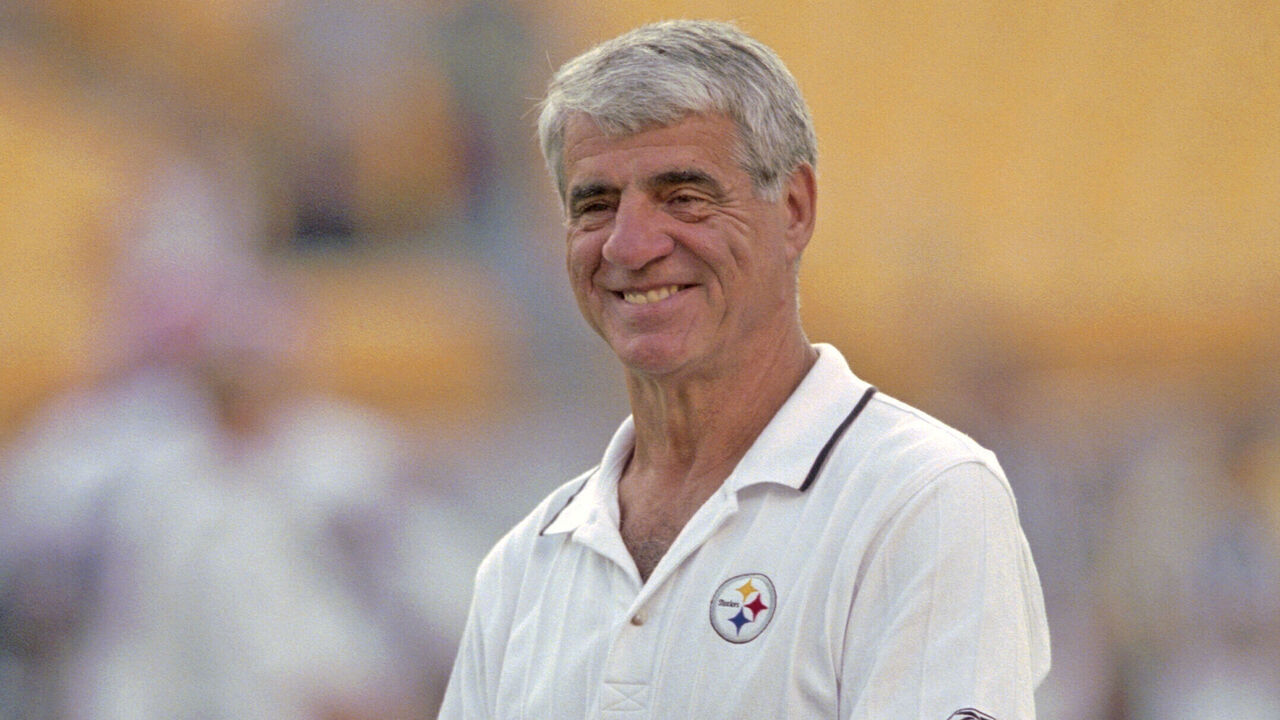
PITTSBURGH (AP) — Dick Hoak, who spent more than 45 years with the Pittsburgh Steelers as a player and then an assistant coach, winning five Super Bowl rings along the way, has died. He was 86.
The team announced Hoak's death on Wednesday. No cause of death was given.
“Dick represented everything the Steelers stand for with his toughness, loyalty, dedication and an unwavering commitment to the team,” team president Art Rooney II said in a statement.
Selected by the Steelers in the seventh round of the 1961 NFL draft after a standout career at Penn State, Hoak ran for 3,965 yards and 25 touchdowns in 10 seasons in Pittsburgh's backfield, leading the then-struggling club in rushing three times.
Hoak, a Pro Bowler in 1968 after running for a career-best 858 yards, retired after the 1970 season and joined coach Chuck Noll's staff as running backs coach in 1972.
Over the next three-plus decades, he served as an important touchstone and mentor for future Hall of Famers like Franco Harris and Jerome Bettis as the Steelers evolved from also-rans to one of the league's marquee franchises.
Many of those Super Bowl-winning teams were powered by the running game that Hoak helped mold. He was so influential and important to the organization that he spanned the tenure of a pair of Hall of Fame coaches in Noll and his successor, Bill Cowher.
Cowher retained Hoak on his staff after replacing Noll in 1992 and credited Hoak for helping him shoulder the difficult task of replacing an icon.
“You embodied everything that being part of the Pittsburgh Steelers represented,” Cowher wrote in a post on X. “Throughout my 15 years as Head Coach, I leaned on your wisdom as I grew as a coach. You were an integral part of 5 Super Bowls. A SPECIAL man who impacted all that knew him!”
While Hoak had opportunities to move on or ascend in the coaching ranks during his extended run in Pittsburgh, he remained loyal to the Steelers as the club won Super Bowl titles after the 1974, 1975, 1978, 1979 and 2005 seasons, teams that featured an offense built around a bruising running game with Hoak mentoring some of the best ever to play the position.
Hoak remains eighth on the team's all-time rushing list, ahead of players he went on to coach like four-time Super Bowl champion Rocky Bleier and two-time Pro Bowler Barry Foster.
“I thought he had a great demeanor with his players, great relationship with his backfield and being able to get a lot out of them made him an awesome assistant coach,” Bleier told Steelers.com. “Secondly, a good friend and a former teammate. It was great to be able to have him in my life, and have that relationship built up over the years.”
Hoak retired in early 2007 after Cowher stepped down. His influence was so great that when the team announced its original Hall of Honor inductees in 2017, Hoak was part of a 27-man class that included nearly two dozen Hall of Fame players.
The Pro Football Hall of Fame honored Hoak in 2025 with its Award of Excellence, given out annually to those in the sport whose work, often behind the scenes, sometimes goes unseen and unappreciated.
Richard John Hoak was born Dec. 8, 1939, in Jeannette, Pennsylvania, about 30 miles east of downtown Pittsburgh. He was an All-State quarterback and defensive back at Jeannette High School before going to Penn State, where he played running back, safety and quarterback. He was named the MVP of the 1960 Liberty Bowl, a 41-12 Nittany Lions win over Oregon, a game in which he passed for two touchdowns, ran for two more and picked off a pair of passes.
The Steelers finished with a winning record just twice in Hoak's 10 seasons as it churned through coaches. Noll's arrival in 1969 signaled the start of a new era, one that was starting to take hold when Hoak retired in 1970.
Less than two years later, Hoak was back at work with the franchise, helping Noll put the finishing touches on a project that once seemed impossible. By the time he retired from coaching, Hoak had five Super Bowl rings and an indelible place in team history.
“He was a guy who was a voice of reason,” Cowher told Steelers.com. "He was a visionary for me that I could lean on to talk about what championship teams felt like, what they looked like, what was the culture that we were trying to build. Are we doing it the right way based on where they were, based on where we are. And he was a conduit for me, a voice of reason, a guy I listened to a lot, an adviser, and a very important part of my growth as a football coach.”
___