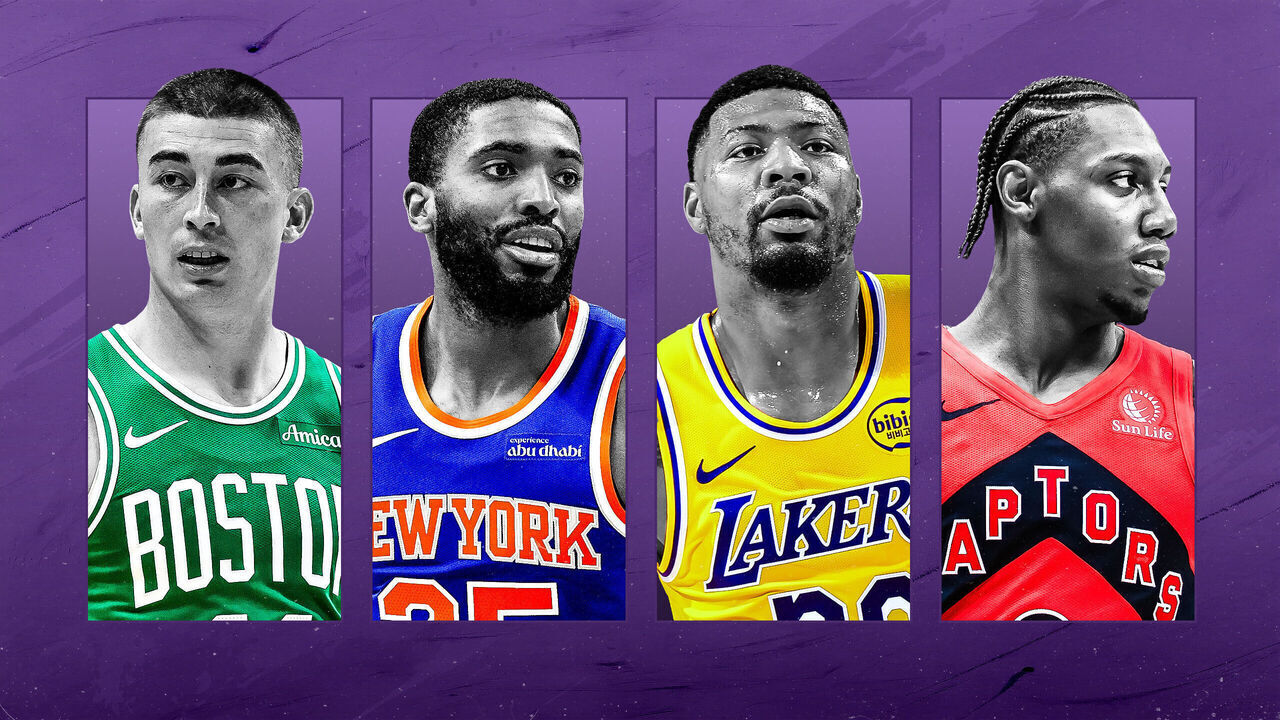
Superstars decide playoff series, but less heralded names often swing them. Below are seven players altering their team's postseason fate, for better or worse.
The Hawks averaged less than 100 points in their three playoff losses and 108 points in their two wins. There's a clear talent discrepancy between New York and Atlanta, but the Hawks' shooting woes (32% from three) are why they're on the brink of elimination. Kuminga is the best barometer of the team's issues.
Although Kuminga's greatest contributions are on defense, Atlanta is 11 points per 100 possessions better when he's on the floor. In the Hawks' two wins, he averaged 20 points while shooting 62% from the field and 38% from three. In the three losses, he averaged 10.3 points on 37% shooting from the field and 7% from deep. Tied as the club's third-leading scorer despite playing the sixth-most minutes, Kuminga will determine whether Atlanta forces a Game 7.
Two superstars aren't enough to win a title without reliable secondary scoring. Jaylen Brown and Jayson Tatum are both averaging over 24 points this postseason against the Sixers, but Pritchard is the only other Celtic in double figures, posting 15 points per game.
With Derrick White's slump carrying over to the postseason, Pritchard is Boston's only other reliable on-ball scorer on the floor. White's averaging 8.1 points on 29.8% shooting from the field and 21.2% from three, making Pritchard's contributions even more important. In Boston's three wins, Pritchard averaged 19.6 points and hit 4.3 threes per game. In its two losses, he managed 8.0 points and 0.5 threes.
The Pistons' issues extend beyond Duren. A lack of secondary scoring and poor shooting destroys their spacing and creates challenges for Cade Cunningham. However, Duren's disappointing postseason isn't helping Detroit's chances of coming back from a 3-1 deficit.
In a potential All-NBA caliber campaign, Duren averaged 19.5 points on 65% shooting. He extended his game away from the basket as a reliable driver and short-roll decision-maker while maintaining a physical presence down low. But all of that has seemingly evaporated in the postseason. Duren is averaging 10.2 points on 50% shooting in the first round, and he's clearly bothered by the Magic's physicality (getting dunked on by Jamal Cain will do that). If the Pistons lose, they could rethink their offer sheet to Duren, who's a restricted free agent this summer.
As the Lakers trailed by six with less than 30 seconds remaining in Game 3, Smart forced a backcourt turnover and drew a foul on a 3-pointer in a matter of seconds. His unrelenting defense and basketball IQ sparked an improbable comeback, and Los Angeles is now up 3-2 in its series against Houston.
While LeBron James' excellence at his advanced basketball age steals the headline, Smart's menacing two-way presence has been the Lakers' true catalyst. His defense has consistently disrupted the Rockets' offense, leading the league with 14 steals in five playoff games. In fact, L.A. has been increasing Smart's minutes since January, which has helped change the trajectory of its defense. Offensively in these playoffs, Smart is often running L.A.'s attack, averaging 16.2 points, 6.4 assists, and drilling 44% of his threes.
Upcoming unrestricted free agent Dosunmu likely secured a pretty penny when he scored 43 points off the bench in the Wolves' Game 4 win. Whether Minnesota can close the Nuggets in one of the next two contests will largely fall on Dosunmu's shoulders. That's a hefty task for a player who's appeared in just 10 playoff games. With Anthony Edwards and Donte DiVincenzo out for the rest of the series, Dosunmu has slid into the role as the Wolves' primary perimeter creator, even as the offense runs through Julius Randle.
Acquired by Minnesota at the trade deadline, Dosunmu is averaging 28.6 points on 65% shooting over his last three games. As he commands more defensive attention, the Wolves' first-round fate is in Dosunmu's hands.
Heavily criticized now, the Bridges trade - which included parting with five first-round picks - was viewed as a worthy haul for the Knicks in 2024. At one time considered the potential missing piece to their championship puzzle, Bridges has struggled to find his place in New York over the last two seasons.
That came to a head in the Knicks' Game 3 loss to the Hawks, with Bridges becoming the first player to score no points, commit at least four turnovers, and post a minus-26 plus/minus since the 1996-97 season - when plus/minus tracking started. New York benched him for most of the second half and reduced his minutes in Games 4 and 5. Bridges is averaging 7.2 points against Atlanta in these playoffs - the lowest mark of his 11 career playoff series.
The Knicks' talent has overwhelmed the Hawks since New York fell behind 2-1. Jalen Brunson is doing Jalen Brunson things, Karl-Anthony Towns is having perhaps his best series ever, and OG Anunoby is connecting on 54% of his threes. Now up 3-2, the Knicks can likely overcome Bridges' ineptitude in the first round. Still, if New York is to achieve its ultimate goal, Bridges needs to become a more aggressive, better version of himself.
Scottie Barnes' superstar potential has surfaced, and the Raptors found themselves a stud in rookie Collin Murray-Boyles, but Barrett is keeping Toronto afloat. Meanwhile, Brandon Ingram was having a terrible series before exiting Game 5 with a heel injury. He's averaged 12 points on 32.8% shooting against the Cavs in these playoffs - well below his regular-season marks of 21 points on 47.7% shooting.
Barrett's scoring and scorching shooting have made up for Ingram's disappointing outings. Averaging 24.4 points, 7.2 rebounds, and 3.8 assists while shooting 46.2% from three, Barrett's impressive production might not be enough to secure a first-round upset. Nevertheless, he's proven to the Raptors why they should give him a contract extension this offseason.