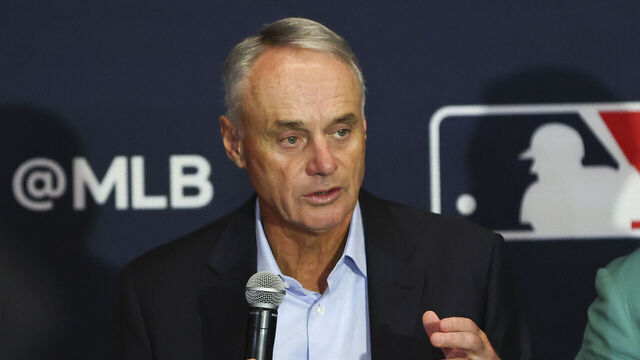
Major League Baseball owners made their long-expected salary cap proposal to the players’ association on Thursday, a system the union has vowed never to accept, setting the sides on course for a confrontation that threatens the 2027 season and perhaps beyond.
Baseball owners hadn’t proposed a firm cap since 1994. Their effort prompted a 7 1/2-month strike that forced the cancellation of the World Series for the first time in 90 years.
MLB's proposal would cap spending in 2027 at $245.3 million, using figures for luxury tax payrolls that include $20.1 million for benefits and the pre-arbitration bonus pool. It also would establish a payroll floor of $171.2 million, forcing some teams to spend more. The Los Angeles Dodgers, baseball's biggest spenders, had a $415.2 million payroll on opening day this year — around $170 million over the proposed cap.
“The cap is pretty much a nonstarter,” Pittsburgh outfielder Bryan Reynolds said.
Owners said they would discuss with the union both a phase-in schedule that would give teams like the Dodgers time to comply with the cap and an escrow system as part of a proposed seven-year deal. In an escrow system, a portion of a player's salary is withheld to ensure the agreed-to-revenue split when final figures are accounted for.
MLB maintained all current contracts would remain guaranteed and there would be no prohibition of guaranteed contracts under the cap system.
MLB said it would centralize local media revenue from the 30 teams equally and give players a 50-50 split as part of a proposal that would eliminate the current revenue-sharing plan among the clubs.
“Our salary cap and floor proposal levels the playing field while sharing baseball revenue with the players 50/50 as we grow the game together,” MLB spokesman Glen Caplin said in a statement. “Further, by sharing media revenue equally as part of our proposal, we can address another top fan concern of local TV blackouts.”
Baseball’s current five-year deal, agreed to in March 2022 after a 99-day lockout, expires Dec. 1. While a lockout next winter is expected, talks are not likely to intensify until late February or early March 2027, when the possibilities of losing regular-season games and revenue near. If regular-season games are lost, negotiations may become a standoff of which side can tolerate the most economic loss.
“Billionaire owners are not seeking to cap their profits or asset values, only player salaries,” union head Bruce Meyer said in a statement. “This isn’t out of generosity or a desire to protect the game’s well-being. It’s a play to control costs, increase profits and maximize franchise values — all at the expense of players past, present and future.”
Based on 2026 opening day figures, eight teams would have to cut payroll to get under the cap. The teams over are the two-time reigning World Series champion Dodgers, New York Mets ($379.2 million), New York Yankees ($339.6 million), Toronto ($319.5 million), Philadelphia ($315.2 million), Boston ($263.7 million), San Diego ($260.1 million) and Atlanta ($247.9 million).
Twelve teams would be required to increase payroll by a total of $617 million based on 2026 numbers: Miami ($81.8 million), Cleveland ($95.7 million), Tampa Bay ($108.2 million), the Chicago White Sox ($108.6 million), St. Louis ($114.4 million), Washington ($119.1 million), Pittsburgh ($122.6 million), Minnesota ($125.6 million), Milwaukee ($130.9 million), the Athletics ($139.2 million), Colorado ($142.2 million) and Cincinnati ($148.8 million).
Owners and the union agreed to a luxury tax in 2003 designed to slow spending, but teams feel it has had little or no impact on the Dodgers and Mets in recent years. The last small-market MLB club to win a World Series was Kansas City in 2015, although Cleveland, Tampa Bay and Milwaukee all lead their divisions as of Thursday, while the Mets and Red Sox are in last place.
MLB said its revenue has grown by 247% since 2003 and player payroll has increased by 149% in that span.
Deputy commissioner Dan Halem and MLB executive vice president of baseball operations Morgan Sword presented the cap plan to players during a bargaining session at the commissioner's office, one day after the union made its economic proposal. Owners say a cap is needed to improve competitive balance and restrain wealthy teams from assembling starrier rosters than their smaller-market brethren.
Players want expanded free agency and salary arbitration rights along with almost doubling the major league minimum, increasing the money high-revenue teams share with the less-wealthy clubs and establishing penalties for teams that drop below payroll floors. MLB's proposal did not address those issues.
Other U.S. major sports leagues operate under a cap. The NBA had a cap in its initial season in 1946-47, then dropped that and began its modern version in 1984-85. NFL players and owners adopted a cap for the 1994 season, and the NHL did so in 2005-06 after a lockout wiped out the entire 2004-05 season.
The Dodgers shattered MLB's spending record with a combined $515 million in payroll and luxury tax last year en route to their second straight World Series title. Los Angeles' total was seven times the $68.7 million payroll of the Marlins, the lowest-spending team, and more than the payrolls of the bottom six clubs combined.
Players say a cap would hurt them, enrich owners and increase franchise values.
“Cap systems are always proposed without any consideration for the billions in franchise value that talent brings to owners," said Scott Boras, baseball's most prominent agent. “The blindness of that concept is something that the Major League Baseball Players Association has dealt with and will continue to deal with as we move forward.”
Without a cap, MLB stars have landed lucrative, guaranteed contracts that outpace what the biggest stars in other U.S. sports leagues make. Juan Soto's $765 million, 15-year contract with the Mets negotiated by Boras is believed to be the biggest in team sports and is far greater than the largest deals in the NFL (Patrick Mahomes at $450 million over 10 years) and NBA (Jayson Tatum at $314 million over five years).
MLB's last salary cap proposal in 1994 offered players a 50-50 split of revenue in a system that would have forced teams to maintain payrolls of 84-110% of the average. Salary arbitration would have been eliminated and the threshold for free agency would have been lowered from six years’ major league service to four — with the provision that a player’s former club could match any offer until he had six years.
MLB's offer came on June 14 that year, and players struck on Aug. 12. MLB withdrew the cap proposal the following Feb. 6 after pressure by the National Labor Relations Board. The strike ended on March 31 after U.S. District Judge Sonia Sotomayor — now a Supreme Court Justice — issued an injunction restoring the work rules of the expired labor contract. Two days later, owners accepted the union's offer to return to work without an agreement. A deal wasn't reached until 1997.
“For generations, our members have fought against cap systems because they harm players at all levels, erode or eliminate contractual guarantees, pit player against player, lead to more work stoppages, not less, and get worse for players over time,” Meyer said. “Caps don’t lower ticket prices for fans, eliminate tanking or ensure teams are run with equal competence. They suffocate competition by offering owners an all-purpose excuse for inaction and mediocrity.”
___
AP freelance writer John Perrotto contributed to this report.
___
AP MLB: https://apnews.com/MLB